


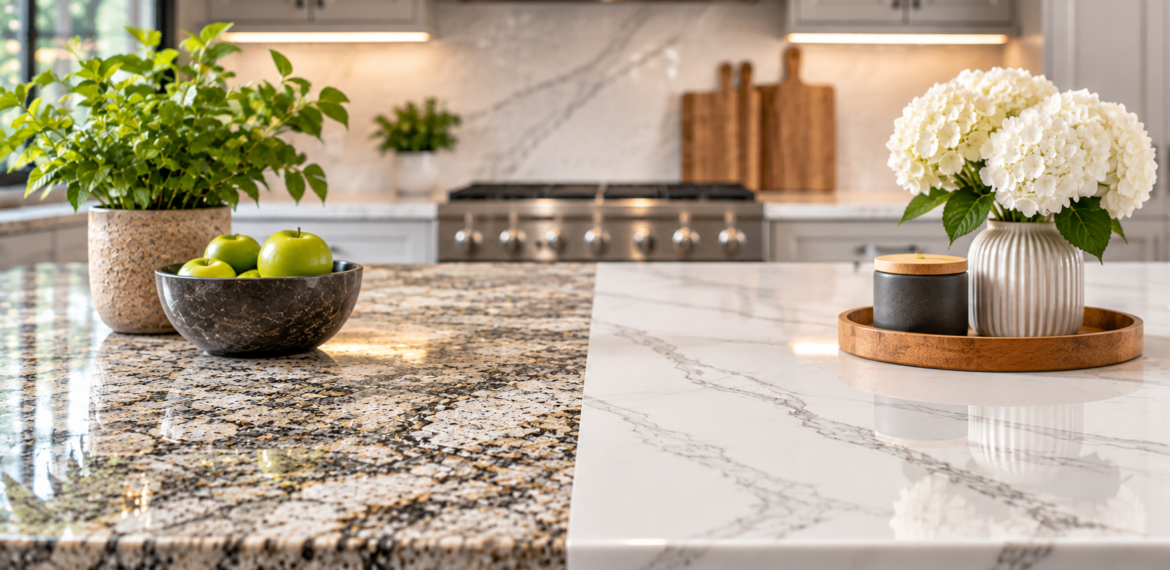
If you are remodeling a kitchen, bathroom, bar area, or laundry room, one of the first decisions you may face is choosing between granite countertops and quartz countertops.
Both are premium materials. Both are durable, attractive, and well suited for everyday homes. The best choice is not about whether granite or quartz is universally “better.” It is about deciding which material best fits your design style, cooking habits, maintenance preferences, and budget.
Granite offers the natural beauty of stone, with unique color, veining, and movement in every slab. Quartz offers a more consistent, low-maintenance surface with a wide range of colors and patterns.
At Star Granite Interiors, we fabricate and install both granite and quartz countertops. Because we work with both materials, our goal is to help homeowners choose the surface that makes the most sense for their project, not push a one-size-fits-all solution.
Granite vs. Quartz at a Glance
Feature | Granite | Quartz |
Material | Natural stone | Engineered surface |
Appearance | Every slab is unique | More consistent color and pattern |
Heat tolerance | Generally excellent | Lower than granite; use trivets and hot pads |
Stain resistance | Good when properly sealed | Excellent; nonporous surface |
Sealing | Usually needed periodically | No sealing required |
Daily maintenance | Low | Very low |
Scratch resistance | Highly durable, but not scratch-proof | Highly durable, but not scratch-proof |
Outdoor use | Often suitable, depending on the project | Generally not recommended for exposed outdoor areas |
Best for | Natural beauty, heat tolerance, outdoor projects | Low maintenance, consistent design, easy cleanup |
What Is the Difference Between Granite and Quartz?
The main difference is simple: granite is natural stone, while quartz is engineered.
Granite: Natural Stone With One-of-a-Kind Character
Granite is formed naturally within the earth, then quarried, cut into slabs, and fabricated into countertops. Because it is a natural material, every slab has its own color variation, mineral deposits, veining, speckles, and movement.
No two granite countertops will ever be exactly alike. That is one of the reasons homeowners continue to choose granite. It adds a natural, custom look that cannot be duplicated by a small sample or a printed pattern.
Granite is also valued for its strength and heat tolerance. With routine care and periodic sealing, it can perform well for decades in kitchens, bathrooms, bars, fireplace surrounds, and many outdoor countertop projects.
Quartz: Consistent, Engineered, and Low Maintenance
Quartz countertops are manufactured from crushed quartz crystals combined with resin and pigments. The result is a durable, nonporous countertop surface available in many colors, finishes, and patterns.
Because quartz is engineered, it offers more consistency than natural stone. Homeowners often choose quartz when they want a uniform color, subtle veining, a marble-inspired appearance, or a controlled look across a large kitchen or multiple rooms.
Quartz does not require sealing. Its nonporous surface resists many everyday spills and makes routine cleaning simple. However, quartz contains resin binders, so it should be protected from direct high heat. Use trivets or hot pads under hot pans, baking sheets, slow cookers, air fryers, and electric cookware.
Is Granite Better Than Quartz?
Neither countertop material is automatically better. The right choice depends on what matters most to you.
Granite is often the better fit for homeowners who want a truly natural surface, enjoy color variation, cook frequently with hot cookware, or are planning an outdoor countertop project.
Quartz is often the better fit for homeowners who want very low maintenance, consistent color and pattern, strong stain resistance, and easy day-to-day cleaning.
The best way to decide is to compare real slabs and colors in person. A small countertop sample can help you narrow your choices, but it cannot show the full movement of a granite slab or the scale of quartz veining across a large kitchen island. View available slabs before making your final selection.
Choose Granite If You Want
- A natural stone countertop with unique movement, color, and character.
- Strong heat tolerance for an active kitchen.
- A material that may work well for an outdoor kitchen or bar.
- A premium surface where no two projects look exactly alike.
- The ability to select the actual slab used for your project.
- A countertop you are comfortable maintaining with periodic sealing.
Choose Quartz If You Want
- A nonporous countertop that does not need to be sealed.
- Consistent color, pattern, and veining throughout the project.
- Easy cleanup for busy kitchens, bathrooms, laundry rooms, or bar areas.
- Strong resistance to common spills such as coffee, juice, cooking oils, and wine.
- A clean contemporary, transitional, or coordinated design.
- A durable surface with very low day-to-day maintenance.
Durability, Scratches, and Everyday Use
Granite and quartz are both highly durable materials for everyday residential use. Either can perform beautifully for decades when it is professionally fabricated, installed correctly, and cared for properly.
Neither surface is indestructible. A heavy object dropped on an exposed edge can chip either material. Sharp knives can scratch the surface and dull the blade. Use cutting boards for food preparation and avoid dragging heavy or rough items across the countertop.
The quality of fabrication and installation matters, too. Proper measurements, cabinet support, seam placement, edge profiles, cutouts, and installation practices all affect how a countertop looks and performs over time.
Heat, Stains, and Maintenance
Heat resistance
Granite generally handles heat better than quartz. It is often the preferred choice for homeowners who cook often and want a countertop with stronger heat tolerance.
Even with granite, it is wise to use trivets and hot pads. Quartz requires more protection from heat because its resin binders can be damaged by very hot cookware or heat-producing appliances. Never place hot pots, pans, baking sheets, electric griddles, slow cookers, or air fryers directly on quartz.
Stain resistance
Quartz has an advantage in stain resistance because it is nonporous. It does not require sealing and resists many everyday kitchen spills.
Granite is naturally more porous, which is why it should be sealed periodically. Once properly sealed, granite resists common household stains very well. Wipe spills promptly, especially oils, wine, coffee, acidic foods, and strongly colored liquids.
Cleaning and care
Both granite and quartz are easy to clean with mild soap, water, and a soft cloth or sponge. Avoid harsh chemicals, abrasive scrubbers, and cleaners that are not intended for stone or engineered quartz.
What About Cost and Home Value?
Granite and quartz can overlap significantly in price. The final cost depends on the specific slab or color selected, square footage, thickness, edge profile, backsplash, cutouts, seam layout, removal of existing countertops, and installation conditions.
Both materials are considered premium countertop choices and can improve a home’s visual appeal. Instead of choosing one material based only on resale value, select the option that fits your home’s style, your family’s needs, and the overall renovation budget.
Why Full-Slab Selection Matters
Choosing a countertop is not only about choosing granite or quartz. The actual slab or color matters just as much.
Granite varies naturally from slab to slab. Seeing the full slab allows you to evaluate its color, pattern, veining, and movement before fabrication begins.
Quartz is more consistent, but seeing a full slab still helps you understand how the veining or pattern will look across a large island, perimeter countertops, backsplash, or vanity.
At Star Granite Interiors, homeowners can view available slabs, compare colors and finishes, and select a surface that works with their cabinetry, flooring, paint, backsplash, and overall design.
A Better Countertop Decision Starts With the Right Team
The finished countertop depends on more than the material. Accurate measurements, thoughtful layout, seam placement, edge profiles, sink and cooktop cutouts, fabrication quality, and professional installation all influence the final result.
Learn more about our work process, from selecting a material through laser templating, shop-drawing review, fabrication, and professional installation.
For inspiration before your visit, explore our gallery of completed projects.
Final Thoughts
The best way to decide between granite and quartz is to see both materials in person.
Visit Star Granite Interiors to compare full slabs, explore colors and finishes, discuss edge profiles, and talk with an experienced team about your kitchen, bathroom, bar, fireplace, or outdoor living-space project.
Ready to get started? Request a free quote or contact Star Granite Interiors to get help.
About the Author
Rick Adams is a second-generation owner of Star Granite Interiors, a family-owned and operated countertop company serving homeowners, builders, and designers throughout South Carolina, North Carolina, and Georgia. Alongside his family, Rick continues the family tradition of providing exceptional craftsmanship, honest guidance, and personalized service for every project.
With decades of combined experience, the Adams family specializes in granite, quartz, quartzite, marble, and other natural stone surfaces. From helping homeowners select the right material to precision fabrication and professional installation, their focus has always been on delivering quality work that lasts.
At Star Granite Interiors, the goal isn’t simply to sell countertops, it’s to educate customers, help them make confident decisions, and create beautiful spaces they’ll enjoy for years to come.
Learn more about Star Granite Interiors, browse our Gallery, or Contact Us to schedule a showroom visit and view full slabs in person.
Rick Adams
Owner | Star Granite Interiors
Elberton, GA
1-800-351-9790
www.stargraniteinteriors.com